Wednesday, 2 March 2011
Curriculum Conferences
The teachers involved in this project will be presenting their work with the Wii at the two Curriculum Conferences in Suffolk on the 15th and 16th March 2011. Resources that have been created during the project to support the use of Wild Earth African Safari, Endless Ocean/Endless Ocean 2, Another Code R and Mario Kart will be available on this blog and the Suffolk Learning Hub at the same time. Also available then will be a request form for Suffolk schools to use to apply to borrow one set of Wii equipment for up to a term.

Thursday, 17 February 2011
Another Code:R-a journey into lost memories


Having spent time exploring this game and unravelling the many dilemmas presented within the storyline, I am beginning to appreciate the benefits of patience. The children have become almost enmeshed in the characterisation of Ashley Mizuki Robbins and her personal quest to find answers to her mother's death. The game relies heavily on Ashley's relationship with her father, as they meet at Lake Juliet after a long period of absence. The lack of audible narration has meant that lengthy periods of dialogue between Ashley and her father have had to read aloud, however the realistic graphics and backgrounds combine with the clever use of flashbacks and motivating challenges,to ensure the children are fully involved in decision making. This engenders a willingness within the class to succeed for Ashley and provides children with an opportunity to share an empathy with a character.
Another Code:R has stimulated extended narrative writing from specific dilemmas, where the children have planned their own resolutions and endings to the story using the concept of a story mountain. There have also been benefits to speaking and listening, where aspects of PSHE have been discussed. We will conclude our work from Another Code:R by writing reviews of the game as contributions for the forthcoming school newspaper. Highly recommended if one can find the time and patience to explore the storyline.
Tuesday, 8 February 2011


Persuasion!
When working of persuasive writing with the children, we looked at different adverts and persuasive texts. The children identified the features of persuasive writing and collected words, phrases and rhetorical questions for future use.
Firstly we studied The Highwayman (Year 5-6 transition unit on the framework). The children had to make a decision about whether The Highwayman deserved to be shot, or simply imprisoned. They collected evidence from the text to support their views and used persuasive writing to use in a court of law. The week finished with a court case involving the whole year group.
This piece of work was very structured and the children received lots of guided writing sessions to support their use of persuasive language.
The following week was a chance for the children to have much more independence within their learning. This was where the use of the Wii came in! We spent a whole session playing different games on the Wii and talking about advantages to owning one. I encouraged children to play competitively and co-operatively as well as consider the variety of games on the market.
Once the children had collected lots of ideas they had to write the speech for a radio advertisement selling the Wii. Once again a significant amount of work was done away from the Wii on the class targets - I can use different structures to organise my writing. I can also use paragraphs to vary pace. Work was done in guided group sessions on beginning each paragraph with an introductory statement. Other than these skills being taught, the children were pretty much left to their own devices. A lot of the writing produced was of a good standard and the children were involved in their learning. Throughout this week, however, it did become apparent if children were not interested in computer games and those who had less experience of using a Wii understandably found it harder to produce persuasive paragraphs.
The next stage was to progress to paragraphing. Our year group target for the term focuses on using paragraphing and structure to organise writing. The children quickly grasped the ideas of paragraphing to organise their writing. I was most impressed with the fact that the use of powerful vocabulary and interesting sentence openers did not slip.


Following on from much work on descriptive learning, we used the Wii to develop our writing into paragraphs. To begin with we taught word and sentence level lessons showing the children how to create adverial and adjectival phrases. In these sessions children were encouraged to use a dictionary and thesaurus.
After this came Mario Kart Wii! At first the children were not even allowed to race, we simply hovered the controller over each of the characters and shared descriptive words and phrases.


Finally the children were allowed to race. Whilst doing so they were encouraged to describe the scenery, thinking about using all of their senses.


All Children were involved and the language produced was of a good quality.
Monday, 31 January 2011
Wild Earth: African Safari
Having been encouraged by the feedback from others who had used this game, I decided to use it to enhance a cross-genre, and cross curricular, writing led project called The Island.
Led by a small text extract, the children construct their own narrative of the strange goings on, on an unnamed island.
I used the game over a series of lessons to build the reality of exploring an alien environment - as in alien to their experience, not aliens of the space kind!- Once the children had grown used to the objective based approach to the game, I began to remove the context, and muted the sound. Over 2 lessons we observed a child 'walking' through the environment, and we began a vocabulary harvest. Recording sights that caught their imaginations, simple things that we asked whoever was playing to focus in on. The good thing about this game is that the player has a camera, and therefore we could zoom in to distant events, or tiny things, such as the shape of leaves, patterns on rocks or the flow of a stream.
We collected both words and phrases, and shared them, whilst the game was still on, narrating the scene.This experience fed into an extended piece of writing about their journey on the Island. Examples are from three groups, extension last.

 Evaluating this has been interesting. There is no doubt that the walkthrough was really productive. I have a very boy-heavy group of year 6s. Many who are very familiar with computer games (obviously) and have found that when I use the game out of its intended context, time needs to be spent on the game itself - or they just won't move on. Once that hurdle is over, the walthrough and narrations really helped many of them.
When discussing this with the children, after we had finished, a few felt that the graphical rendering may have limited their own imaginations. It is important to note that I have observed the opposite on our current project - a write-up of which shall be posted by the end of the week.
Toby.
Led by a small text extract, the children construct their own narrative of the strange goings on, on an unnamed island.
I used the game over a series of lessons to build the reality of exploring an alien environment - as in alien to their experience, not aliens of the space kind!- Once the children had grown used to the objective based approach to the game, I began to remove the context, and muted the sound. Over 2 lessons we observed a child 'walking' through the environment, and we began a vocabulary harvest. Recording sights that caught their imaginations, simple things that we asked whoever was playing to focus in on. The good thing about this game is that the player has a camera, and therefore we could zoom in to distant events, or tiny things, such as the shape of leaves, patterns on rocks or the flow of a stream.
We collected both words and phrases, and shared them, whilst the game was still on, narrating the scene.This experience fed into an extended piece of writing about their journey on the Island. Examples are from three groups, extension last.


 Evaluating this has been interesting. There is no doubt that the walkthrough was really productive. I have a very boy-heavy group of year 6s. Many who are very familiar with computer games (obviously) and have found that when I use the game out of its intended context, time needs to be spent on the game itself - or they just won't move on. Once that hurdle is over, the walthrough and narrations really helped many of them.
When discussing this with the children, after we had finished, a few felt that the graphical rendering may have limited their own imaginations. It is important to note that I have observed the opposite on our current project - a write-up of which shall be posted by the end of the week.
Toby.
Tuesday, 7 December 2010
Recount writing using Endless Ocean


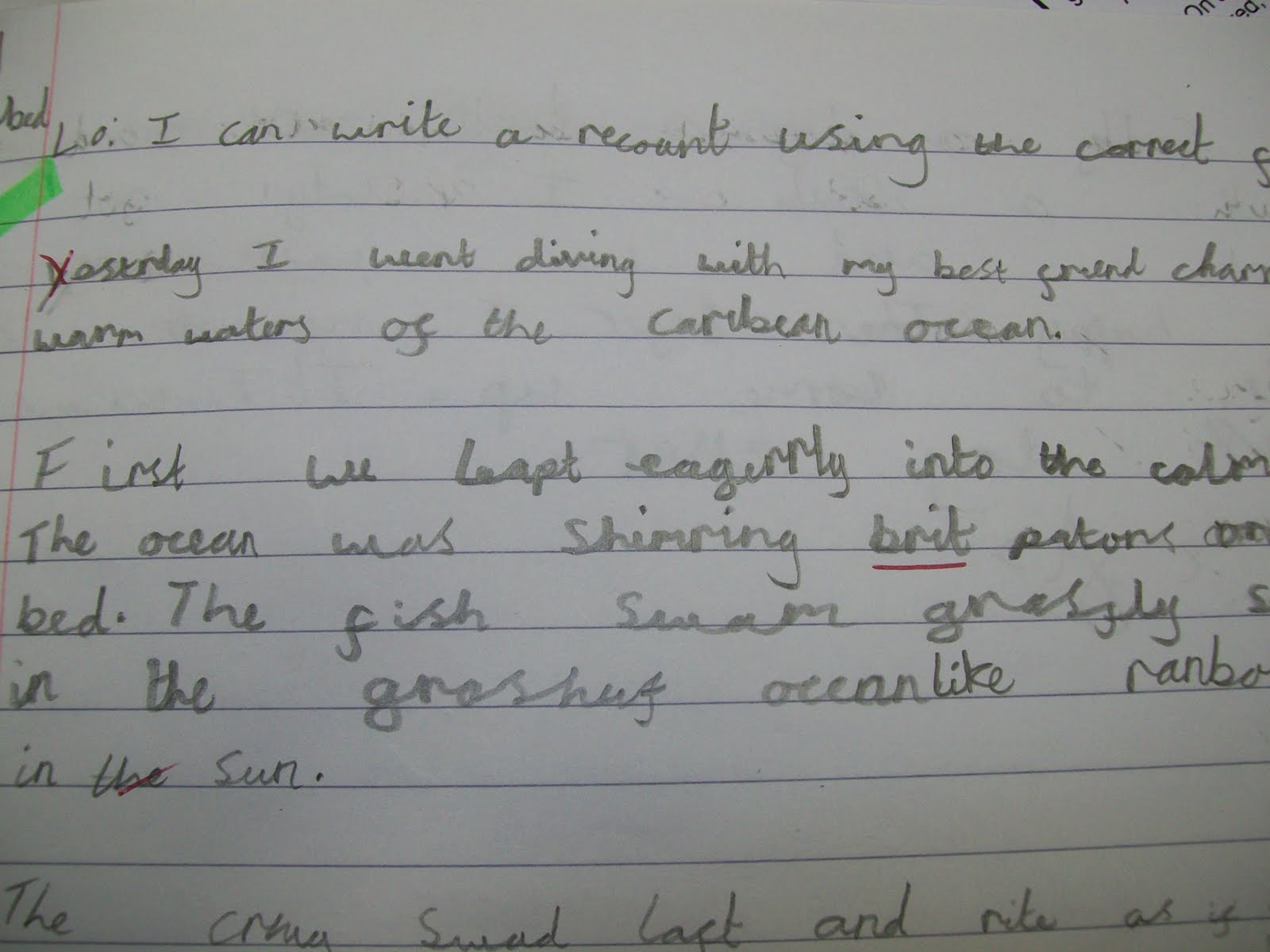


The language the children used impressed us in this task. They used lots of descriptive vocabulary and phrasing inspired by a swim in the lagoon. However they found it difficult to stick to the form, structure and style of a recount - they were concerned with telling the reader about every fish they saw in the order they saw them, generating an extensive and detailed list rather than a recount. Also when it came to drawing the writing to a close, they seemed to struggle with ending the recount in role, rather than describing what happened as part of the game.
Phil and Helen
Subscribe to:
Posts (Atom)